Where the Health Fund's Money Went
Every dollar in and out of the joint Town/BOE Health Insurance Reserve Fund, July 2022 – June 2026
What the cash-flow report shows, before any chart
The five-page cash-flow analysis itemizes every dollar that moved through the joint Town/BOE Health Insurance Reserve Fund for 48 consecutive months (FY 2022-23 through FY 2025-26). Extracting and re-adding every line:
- All 48 months reconcile exactly. For every month, beginning balance + recorded inflows − recorded outflows equals the ending balance to the penny, and BOE + Town columns sum to the Combined column throughout.
- Every outflow is an itemized health-plan cost — medical/Rx claims, stop-loss premiums, employer HSA funding, plan administration, PPI benefits, actuarial services, state assessments, excise taxes. The report records no transfers to any other fund or purpose.
- The balance fell because plan costs outran deposits: $31,687,129.59 went in, $34,284,043.00 of plan costs went out, and the difference — $2,596,913.41 — is exactly the drawdown from $3,280,960.41 (July 1, 2022) to $684,047.00 (June 30, 2026).
- Deposits kept pace with the adopted budget lines. BOE employer deposits exceeded the adopted ERI line (41210) in FY 23-24, FY 24-25 and FY 25-26; town deposits tracked the town health line (41211), exceeding it in FY 23-24 and FY 24-25 (the FY 25-26 adopted value isn't in the dataset yet).
Each option below is a working chart built from that extraction; the visuals argue the same conclusion different ways. This page is a companion to The Health Insurance Fund, which tells the budget-line side of the same story.
OPTION 0Audit-summary stat tiles
A KPI row for the top of the page — the reconciliation result stated as numbers, before any chart. Works as a header for whichever options follow.
OPTION P1The fund as a bucket, year by year
No chart skills needed: the fund is a bucket. Money is poured in every year; health-care bills drain it. The water line shows where each year started and ended.
Table view
OPTION P2Where every $100 that left the fund went
All four years of spending, shown as 100 dollar-squares. Hover any square for the category total.
Table view
OPTION P3The whole four years in one picture
Three boxes: what went in, the bucket it sat in, and the bills it paid. July 2022 through June 2026.
Table view
OPTION P4If the fund were a checkbook
The most familiar money record there is: a check register. Deposits in, checks out, running balance after every line — to the penny. Every check category is a health-plan payee.
OPTION P5The four-year receipt
Everything on one receipt: what went in, what was paid out, and the line most people are asking about — printed at the bottom.
OPTION AEvery dollar in, every dollar out (flow diagram)
All cash through the fund, four years combined. Left: where the money came from. Right: where it went. Ribbon widths are proportional to dollars; nothing leaves the diagram unlabeled.
Table view
What has the fund’s balance done month by month?
OPTION BMonthly fund balance, 48 months
The balance draws down across the 48 months, and each month’s change equals the sum of that month’s itemized activity.
Table view (monthly balances)
In one year, where did every dollar come from and go?
OPTION COne year, dollar by dollar (waterfall)
The last bar is drawn from the arithmetic of the bars before it, and it lands on the ending balance the report gives.
Table view (annual flows)
Over time, did the money going in cover the plan costs going out?
OPTION DCumulative money in vs. plan costs out
Plan costs (rust) grew faster than deposits (blue), and the vertical distance between the lines at any month equals the fund’s cumulative balance change to that month.
Table view (cumulative by month)
Did the school side deposit what its budget line held?
OPTION EBudgeted line vs. dollars actually deposited
BOE deposits exceeded the adopted line in each of the last three years, reaching 135% of the line in FY 25-26.
BOE — adopted ERI line 41210 vs. deposits
Town — adopted line 41211 vs. deposits
Table view
Where did the school budget line end up, dollar for dollar?
OPTION E2Tracing the BOE budget line, dollar for dollar
In FY 22-23, ERI actuals of $3,746,275 were $3,517,411 deposited to the fund plus about $228,864 of benefits paid outside it, with about $75,904 of the line unspent at printing.
Table view (including FY 19-20 – FY 21-22 actuals context)
What did the fund pay for, year by year?
OPTION FWhat the fund paid for, year by year
Claims are 73–85% of outflows every year; the remainder is stop-loss premiums, employer HSA funding, and plan administration.
Table view (outflows by category)
OPTION GThe reconciliation record, month by month
One tile per month. A tile is green only if that month's beginning balance plus itemized inflows minus itemized outflows equals its ending balance exactly. Hover any tile for the arithmetic.
Table view (monthly reconciliation)
SCOPEWhat this analysis shows — and what it can't
This page verifies that the town's cash-flow records for the Health Insurance Reserve Fund are complete and internally consistent: every dollar in and out is itemized, all 48 months reconcile exactly, and every recorded outflow is a named health-plan cost. It does not re-audit the underlying payments — confirming that each claims check went to a legitimate claim is the job of the town's independent annual audit and the forensic audit of the fund the Board of Education commissioned from Shipman & Goodwin in February 2026. What arithmetic can establish is this: within the town's own records, there is no month, no line, and no dollar routed anywhere other than the health plan — and those records agree with every independently published figure we can test them against, below.
CHECK-1Independent corroboration — every public figure, tested
Numbers published outside this analysis, compared against the cash-flow report. Agreement across sources the town cannot retroactively harmonize is the strongest available evidence the records are genuine.
| Published figure (source) | Cash-flow report | Result |
|---|---|---|
| Reserve "about $3.7M" in 2022 (Inside Investigator) | BOE column, 6/30/22: $3,616,529.20 | ✓ matches (BOE column) |
| Reserve low "about $854,000" in FY 24-25 (Inside Investigator) | BOE column, 6/30/25: $854,251.59 | ✓ matches (BOE column) |
| Claims "about $3.6M" in FY 22-23 (Inside Investigator) | BOE claims, FY 22-23: $3,675,796.91 | ✓ matches |
| Claims "about $6M" in FY 24-25 (Inside Investigator) | BOE claims, FY 24-25: $6,034,608.56 | ✓ matches |
| Town to pay its Apr–Jun employer contributions immediately (First Selectman's Report, 4/10/26) | Town deposit, Apr 2026: $361,701.82 = exactly 3 × the $120,567.26 monthly contribution | ✓ matches to the cent |
| "Town side to float April and potentially May claims for the BOE" (First Selectman's Report, 4/10/26) | BOE column dips to −$9,629.44 at end of April 2026; combined fund stays positive | ✓ matches |
| BOE requests $945,000 allocation for the fund's anticipated deficit (First Selectman's Report, 4/10/26) | BOE deposit, May 2026: $960,757.60 | ✓ consistent |
| Self-insured plan; fund pays claims up to $125,000 each before stop-loss insurance takes over (Inside Investigator) | Stop-loss premium and reimbursement rows appear exactly as that structure implies | ✓ consistent |
CHECK-2One fund, two columns — the negative-balance question, answered before it's asked
The reserve is a single joint fund with two bookkeeping columns, BOE and Town. Deposits and bills on each side land on their own schedules, so a column can run temporarily negative while the combined fund never does. Both things happened, in both directions, and both are visible in every table on this page:
- The Town column ran negative from FY 22-23 to mid-FY 24-25 (deepest: −$939,034.96 at end of January 2024) — combined cash covered town-side bills ahead of town deposits.
- The BOE column dipped to −$9,629.44 at the end of April 2026 — and this time the Town side floated the BOE, exactly as the First Selectman's Report of April 10, 2026 said it would.
- Both columns ended positive on June 30, 2026 (BOE $448,037.85; Town $236,009.15). Neither side kept the other's money; the timing washed out inside the fund.
This is cash-flow timing inside one shared account — the same thing a couple's joint checking account does when one paycheck lands before the other's bills clear. It is not money leaving the fund; no dollar left the fund for any purpose but the health plan.
CHECK-3What "plan administration" actually is
The one outflow category that isn't a medical bill, itemized — because a vague category invites suspicion.
| Fiscal year | Admin costs | Share of year's outflows | Pattern in the report |
|---|---|---|---|
| FY 22-23 | $1,052,740.74 | 16.7% | A similar fee every month (≈$76K–$119K) — the flat monthly signature of TPA/network charges, which in these years bundled stop-loss coverage |
| FY 23-24 | $804,984.79 | 9.6% | Same monthly-fee pattern |
| FY 24-25 | $1,120,242.32 | 12.9% | Same monthly-fee pattern |
| FY 25-26 | $160,533.63 | 1.5% | Drops by ~$1M — because stop-loss moved to its own named rows (below); the drop matches the amount that moved |
In FY 25-26 the report itemizes the stop-loss arrangement explicitly: premiums billed under "Aegle Capital Stop Loss" ($9,980.00) and "H&M Billing Stop Loss" ($979,758.00) — Aegle Capital is a healthcare risk-financing firm — with reimbursements flowing back into the fund when large claims exceeded the $125,000 stop-loss threshold: $1,349,925.29 (Aegle) + $45,090.42 (HM), plus $272,353.17 in pharmacy-rebate recoveries. Stop-loss is how a self-insured plan buys catastrophic-claim protection; the reimbursement rows are that protection paying out.
CHECK-4The paper trail for every large deposit
Deposits above the normal monthly pattern in FY 25-26, and where each is documented.
| Deposit | Amount | Documentation |
|---|---|---|
| Aug 2025 (BOE) | $1,719,071.65 | FY 25-26 adopted-budget funding of the ERI line; authorizing minutes to be linked (BOE/BOF, summer 2025) |
| Oct 2025 (BOE) | $1,726,185.96 | Same — authorizing minutes to be linked |
| Apr 2026 (Town) | $361,701.82 | ✓ First Selectman's Report, April 10, 2026: Town paying April–June contributions at once (3 × $120,567.26) |
| May 2026 (BOE) | $960,757.60 | ✓ Follows the BOE's $945,000 allocation request from year-end funds + SpEd excess-cost reimbursement (First Selectman's Report, April 10, 2026) |
The FY 26-27 proposed budget continued this repair — raising the ERI line to $7,416,405 with the stated rationale "Increase cost of Health Insurance and restoring reserve" — but was defeated at referendum in May and July 2026 and is not adopted. Two rows above await their meeting-minute citations; they are marked, not hidden.
SOURCEThe source document — all five pages
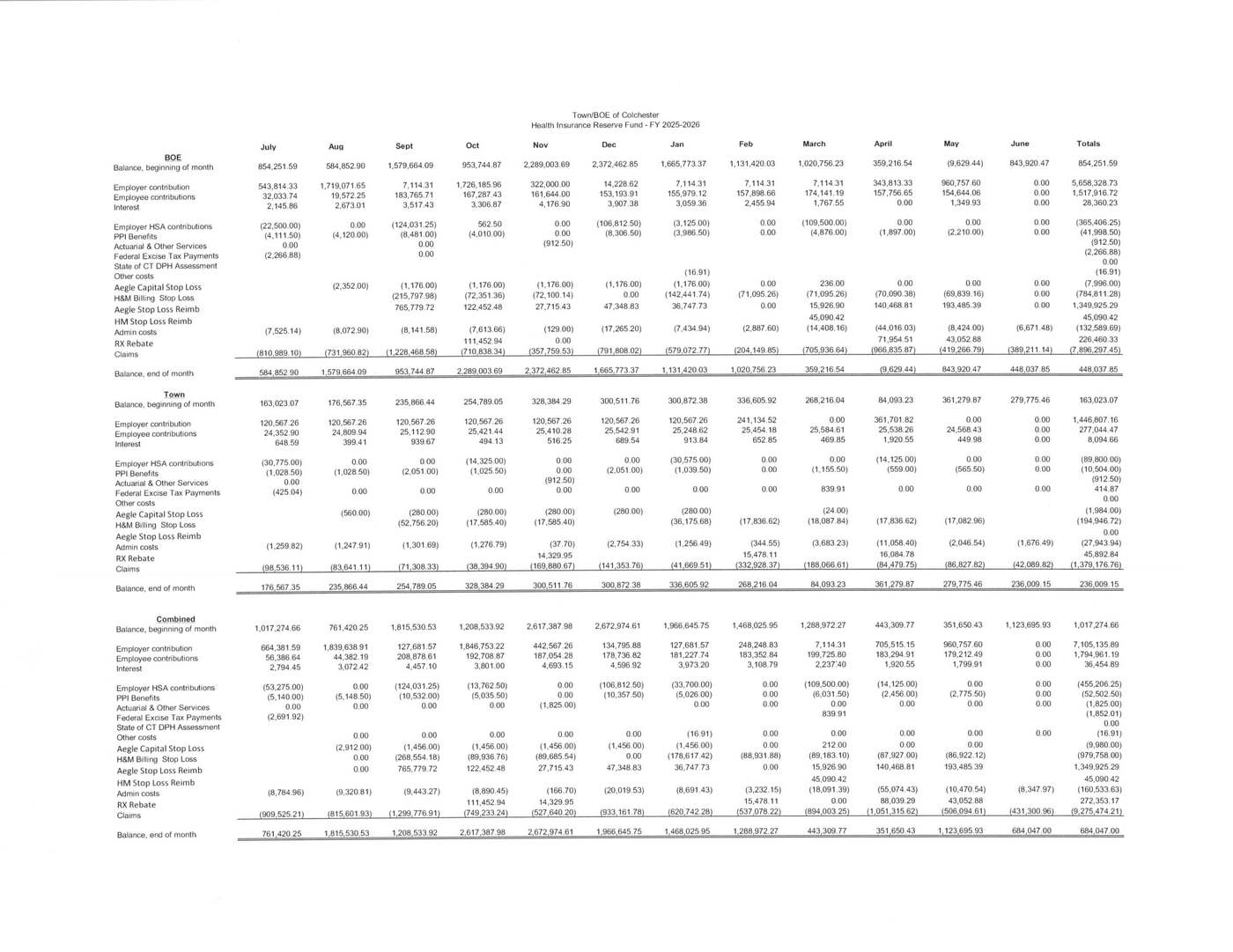
The complete scanned cash-flow analysis this page is built from. Every figure on this page traces to one of these pages; every chart has a table view for line-level comparison.
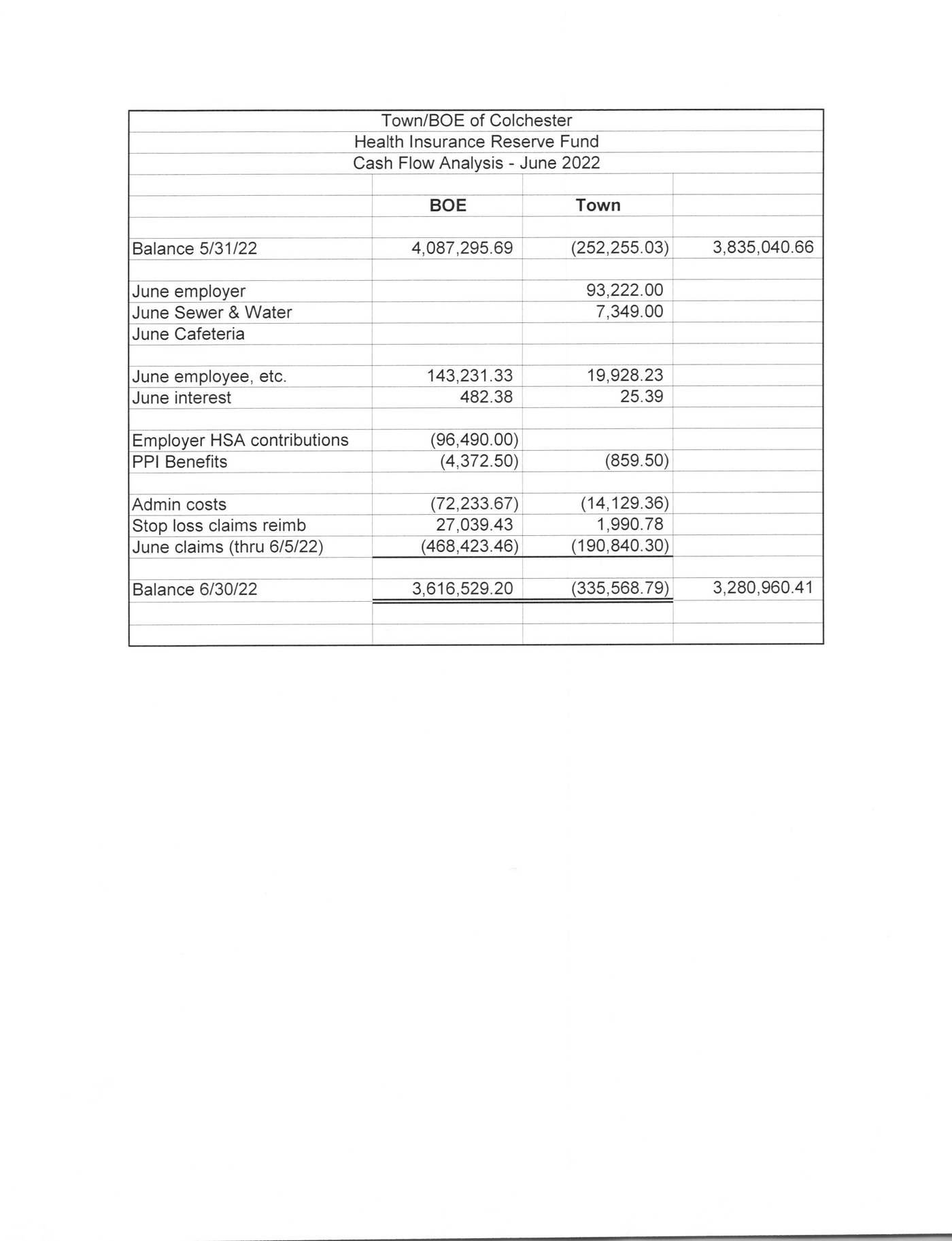
Page 1 — June 2022 (the month before the series begins)
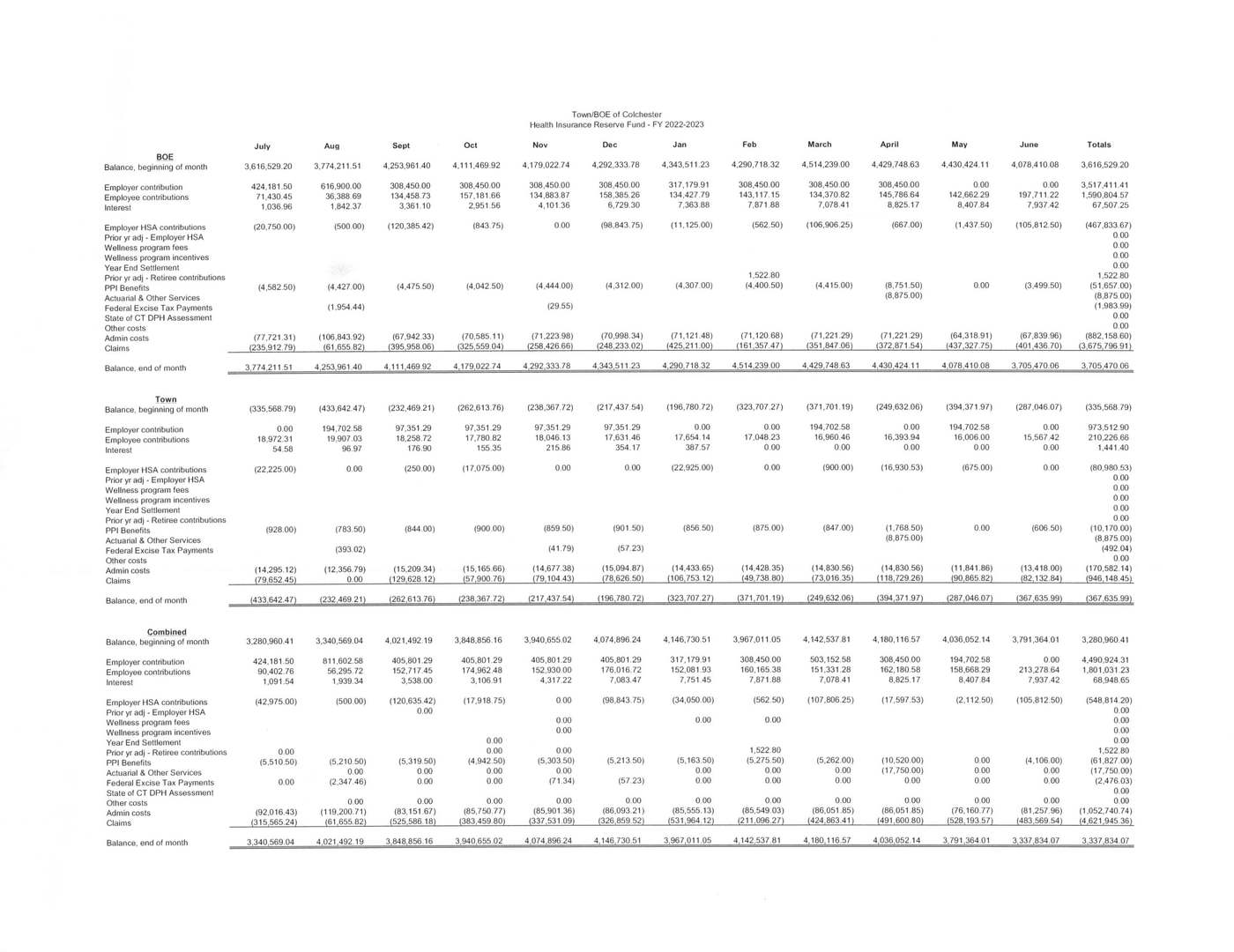
Page 2 — FY 2022-23, monthly (BOE / Town / Combined)
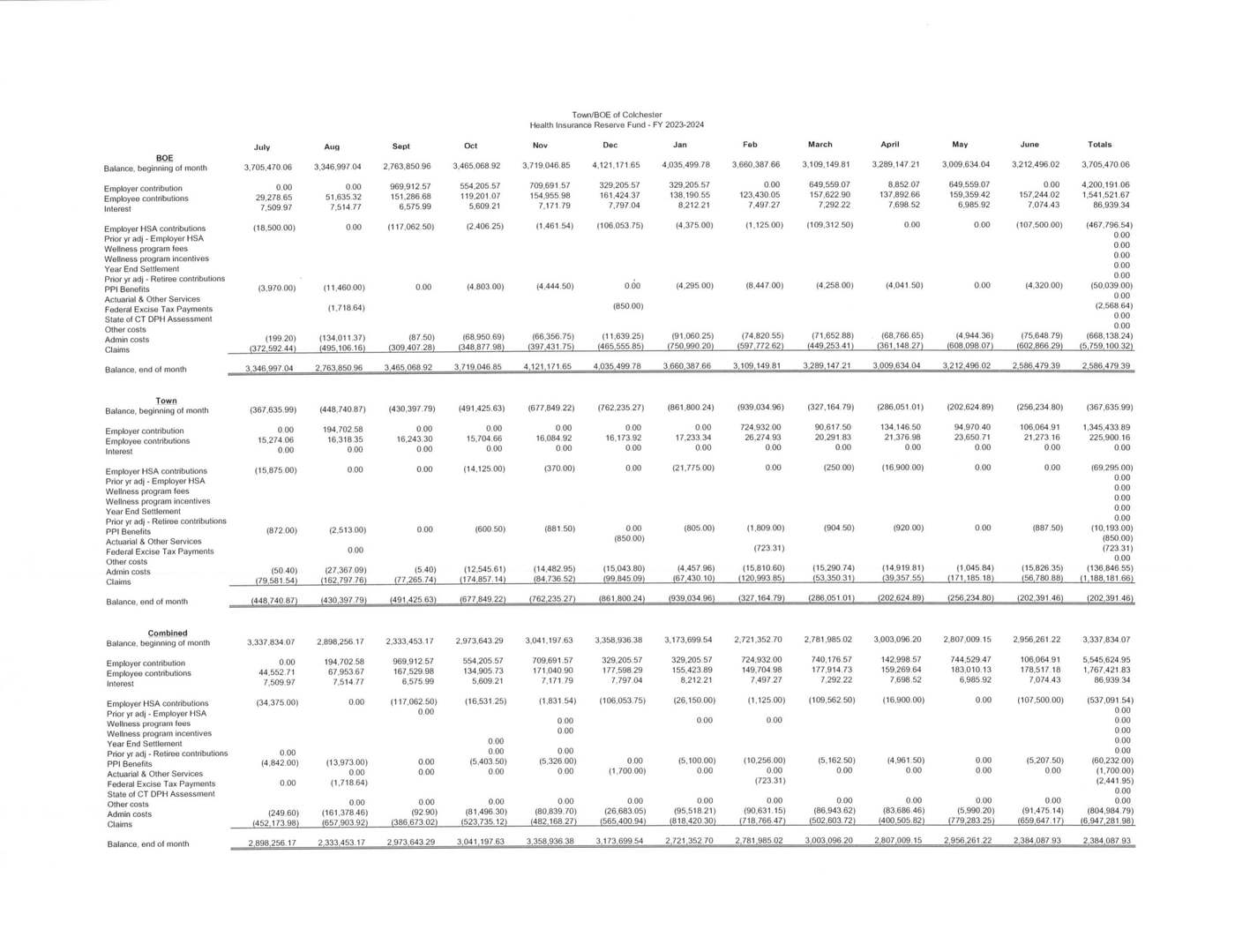
Page 3 — FY 2023-24, monthly
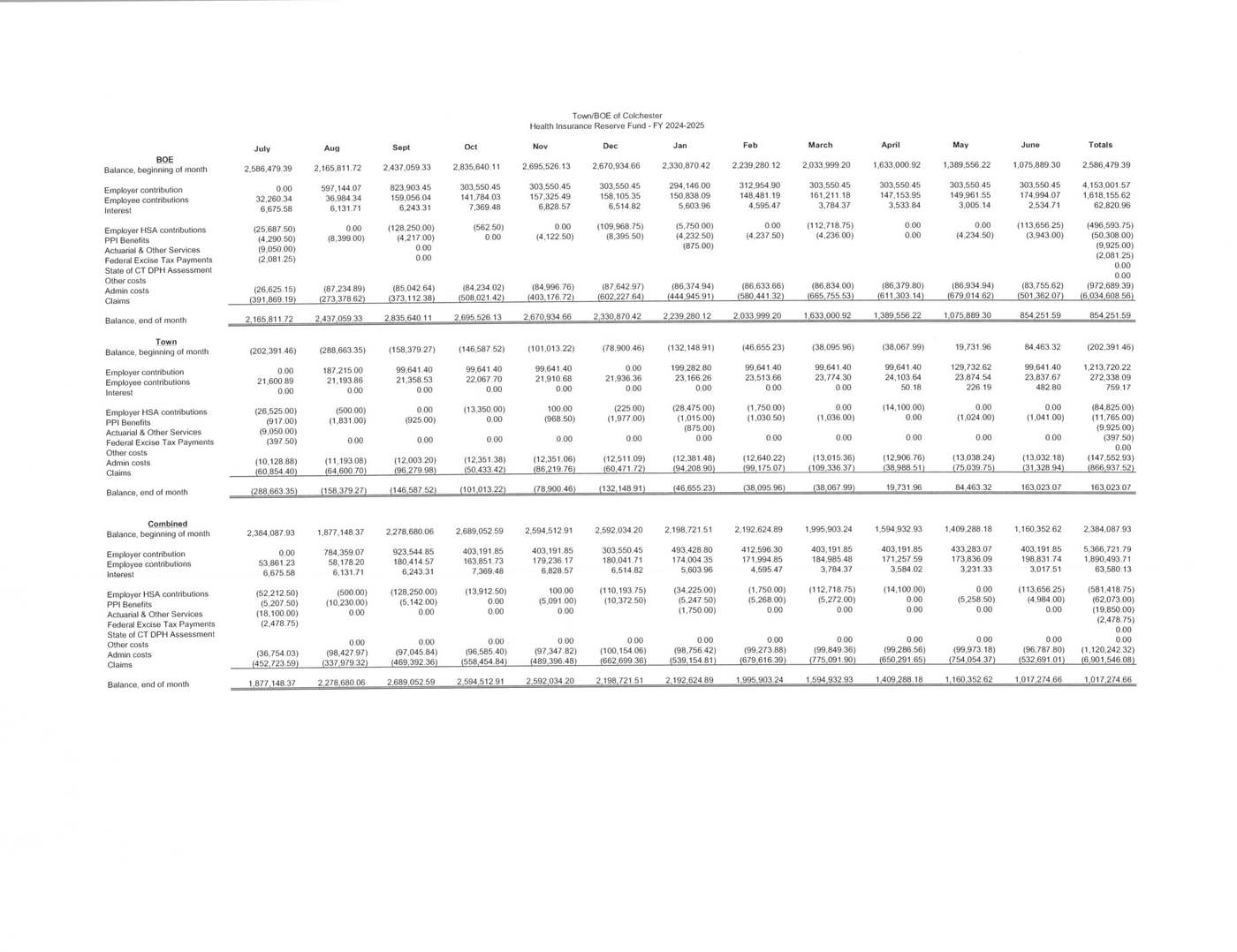
Page 4 — FY 2024-25, monthly
Page 5 — FY 2025-26, monthly (adds itemized stop-loss rows)
FAQObjections, answered
"These are the town's own numbers — of course they balance."
Internal consistency is only half the test; the other half is agreement with sources the town doesn't control after the fact. See CHECK-1: press-reported balances and claims, and pre-announced deposits, all match the report — some to the cent. And the records remain subject to the independent annual audit and the Shipman & Goodwin forensic audit.
"You read this off a scan. OCR makes mistakes."
It does — which is why every number had to survive three simultaneous arithmetic checks (see Method above). A misread digit cannot hide: it breaks a monthly balance equation, a row total, or the BOE+Town=Combined identity. All 48 months close with $0.00 residue.
"You cherry-picked the window."
The window is the town's report, which begins June 2022. The budget-line history back to FY 2007-08 is already published on this site's Insurance Costs page, and earlier fund records would be a welcome addition — this page will incorporate them if the town produces them.
"The Town/BOE columns went negative — that's using the money for something else."
That's timing inside one joint account, in both directions at different times, publicly documented while it was happening, and fully unwound by June 2026. See CHECK-2.
"$3.4M of 'administration' could hide anything."
It has the flat monthly signature of TPA fees, and when stop-loss billing was separated in FY 25-26, admin fell to $160,533.63 — the category decomposed exactly as labeled. See CHECK-3.
"Deposits were bigger than the budget line. Where did that money come from?"
From documented budget actions: the adopted ERI line, year-end unexpended funds, special-education excess-cost reimbursement, and the town's accelerated contributions — each large deposit is listed with its source in CHECK-4.
"Your FY 22-23 'actual' is only year-to-date."
Correct, and the page says so. The as-printed figure ($3,746,275.40, FY 23-24 budget book p.21) already accounts for 98% of the adopted line; the final figure sits in the district's year-end report and later budget books, and this page will adopt it when available.
"HSA money goes to employees, not medical bills."
Employer HSA funding is part of the negotiated health plan: deposits into employees' health savings accounts under the high-deductible plan design. It is a health benefit, itemized as such in the report.
"The paper said $854K. You say $1,017,274.66. Which is it?"
Both — same report, different columns. $854,251.59 is the BOE column at 6/30/25; $1,017,274.66 is the combined Town+BOE fund. Every chart's table view shows both columns.